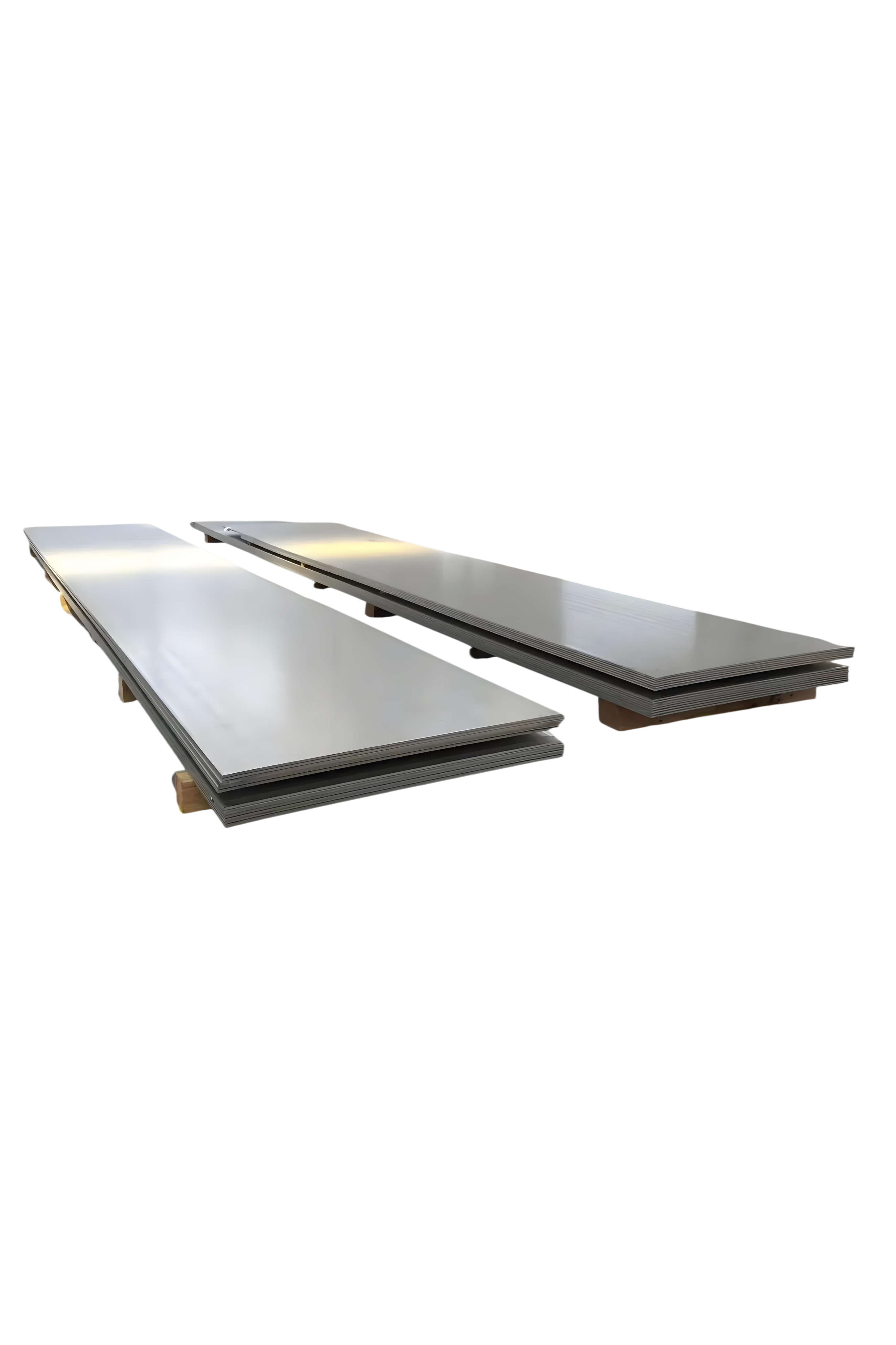
304 Stainless steel sheet
Premium 304 stainless steel sheet with excellent corrosion resistance and formability. The most widely used stainless grade for construction, food processing, kitchenware, and industrial applications.
Product Details
304 stainless steel is a common type of stainless steel material, with a density of 7.93 g/cm³. It is also known as 18/8 stainless steel, indicating that the chromium content is ≥18% and the nickel content is ≥8%. It was invented by William A. Hatfield of the FirthBrown Laboratory in the UK in 1924 through an improvement of the "V2A" process. Its chemical composition also includes manganese ≤ 2% and elements such as silicon, phosphorus, and sulfur. The recommended usage temperature range is -196°C to 800°C, but if prolonged exposure is required, it is recommended not to exceed 500°C to avoid sensitization.
The new designation 06Cr19Ni10 in the national standard is a new brand of 304 stainless steel. The 18/10 stainless steel in the European standard EN10088-3:2014 is similar to it, and the "GB 4806.9-2023" implemented in September 2023 further regulates the migration quantity indicators of food-grade stainless steel. Common marking methods in the market include 06Cr19Ni10 (GB/T 20878-2024), SUS304 (Japanese JIS), and 304 (American ASTM A959-19). This material is formed through cold processing, hot processing, and welding, and is suitable for processing methods such as stamping, bending, and arc welding.
304 stainless steel is one of the most widely used chromium-nickel stainless steels. As a widely used steel, it has good corrosion resistance, heat resistance, low-temperature strength, and mechanical properties; it has good heat processing properties such as stamping and bending, and no heat treatment hardening phenomenon (operating temperature -196°C to 800°C). 304 stainless steel is resistant to corrosion in the atmosphere, but in industrial atmospheres or polluted areas, it needs to be cleaned in time to avoid corrosion. It is suitable for food processing, storage, and transportation, and has good processing performance and weldability. 304 stainless steel is also widely used in the manufacture of household items (1st and 2nd class tableware, cabinets, indoor pipelines, water heaters, boilers, bathtubs), automotive parts (windshield wipers, mufflers, molds), medical equipment, building materials, chemical equipment, agricultural machinery, ship components, etc. The 304 stainless steel with strictly controlled content can also be called food-grade 304 stainless steel.
Most of the usage requirements are to maintain the original appearance of the building for a long time. When determining the type of stainless steel to be selected, the main considerations are the required aesthetic standards, the corrosiveness of the local atmosphere, and the cleaning system to be adopted. However, other applications increasingly seek structural integrity or impermeability. For example, the roofs and side walls of industrial buildings. In these applications, the construction cost of the owner may be more important than aesthetics, and a less clean surface is acceptable. In dry indoor environments, the use of 304 stainless steel is quite effective. However, in rural and urban areas to maintain its appearance outdoors, it is necessary to frequently clean. In polluted industrial areas and coastal regions, the surface will be very dirty and even rusted.
But to achieve aesthetic effects in outdoor environments, nickel-containing stainless steel is required. Therefore, 304 stainless steel is widely used for curtain walls, side walls, roofs, and other building applications, but it is best to use 316 stainless steel in highly corrosive industrial or marine atmospheres. Compared with the traditional 304 stainless steel, 304 stainless steel has higher corrosion resistance. People have fully recognized the superiority of using stainless steel in structural applications. Several design criteria include 304 and 316 stainless steel. Because the "duplex" stainless steel 2205 integrates good atmospheric corrosion resistance and high tensile strength and elastic limit strength, this steel is also included in the European standards. In fact, stainless steel is produced and manufactured in full standard metal shapes and sizes, and there are many special shapes. The most commonly used products are made from thin sheets and strip steel. Special products are also produced using medium-thick plates. For example, hot-rolled structural steel and extruded structural steel are manufactured. Moreover, there are circular, elliptical, square, rectangular and hexagonal welded pipes or seamless pipes, as well as other forms of products, including profiles, bars, wire rods and castings.